Drawing Hands: What Really Matters
Hands are considered one of the most difficult subjects to draw. There are countless tutorials about anatomy, proportions and methods that begin by constructing hands from boxes, circles and cylinders. That can be helpful but it can also make the subject more complicated than it needs to be.
When I draw hands, I rarely think about every individual bone. What matters much more to me are a few visual characteristics that make a hand look believable. A simplified hand with the right characteristics can work better than an anatomically perfect hand where these observations are missing.
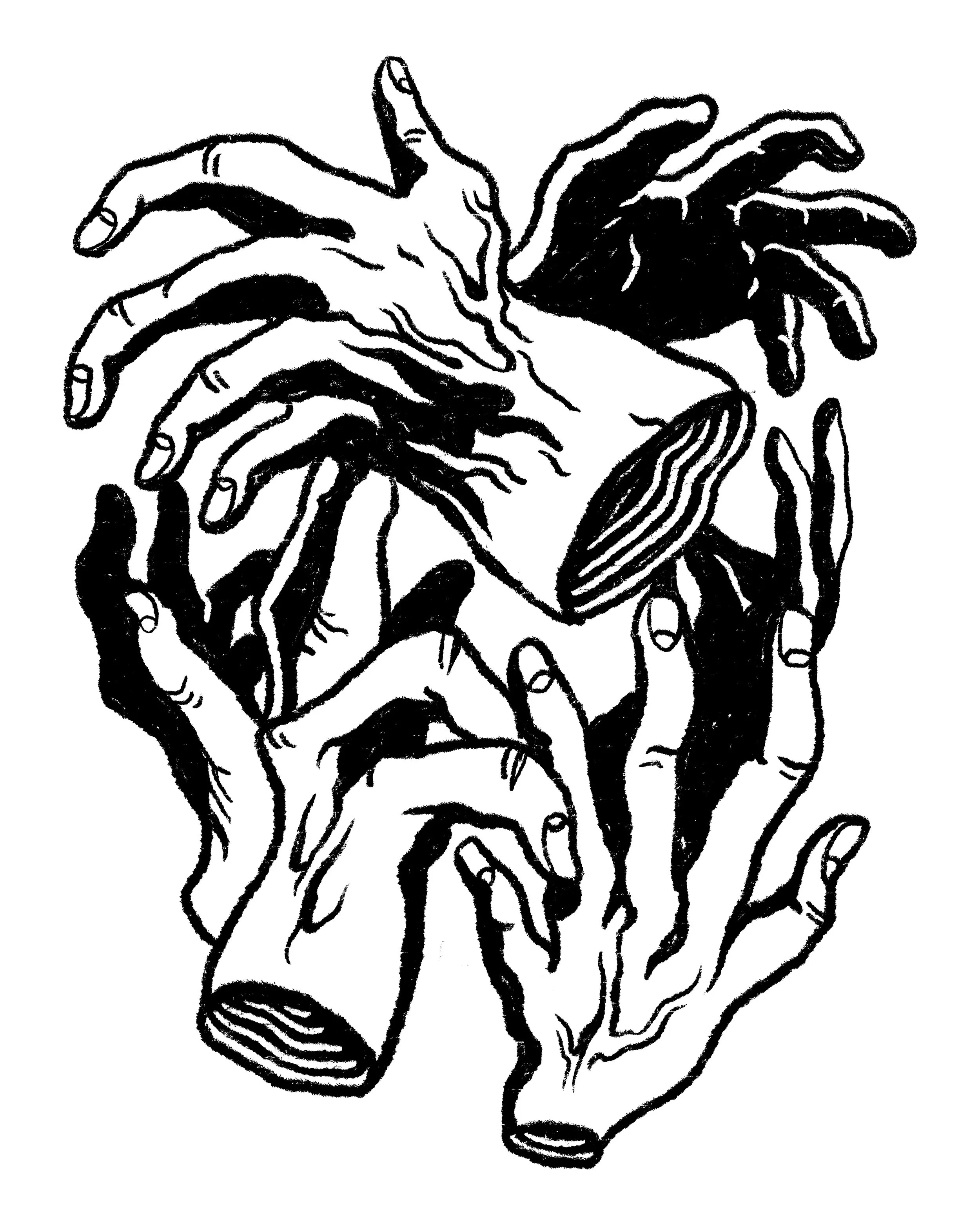
Fingers Are Not Smooth Tubes
One of the most common mistakes is drawing fingers like small sausages. A smooth and even contour runs from the base all the way to the fingertip. In reality, the shape of a finger changes constantly.
The main reason for this is the joints. Look at your own index finger from the side. The contour becomes wider and narrower at certain points and repeatedly changes direction slightly. This becomes especially noticeable when the finger is bent.
Instead of seeing a finger as one long curve, you can think of it as several sections. The joints create a rhythm and that rhythm is exactly what makes a finger feel believable.
You do not need to draw the joints in detail. It is often enough to consider how they affect the outer shape.
Fingertips Are Not Simply Round
One small detail that can make a surprisingly big difference is the fingertip. We often imagine fingertips as perfectly round. When you look at them more closely, however, they have a much more specific shape.
The underside has more volume because of the finger pad while the fingernail influences the upper side. Depending on the perspective, the end of a finger can therefore appear slightly flattened, angular or almost square.
If every finger ends in a perfect semicircle, a hand can quickly look inflated or cartoonish. Just two or three small changes in direction along the contour can make a fingertip appear much more believable.
These small observations are often more important when drawing than adding extra details.
Pay Attention to the Rhythm of the Fingers
The fingers do not all begin at the same height. Their bases and knuckles create more of an arc. The middle finger sits higher, the index and ring fingers slightly lower and the little finger begins noticeably further down.
Their movement is not completely independent either. Fingers often behave like groups. Two may sit close together while another separates from them. Three fingers might be bent in a similar way while the index finger makes a completely different movement.
Recognizing this is especially helpful for illustrations. You do not need to draw every finger with the same level of detail. Instead, ask yourself which fingers explain the action. When holding a cup, for example, the thumb and index finger are particularly important. The remaining fingers can partly become one shared shape.
The Thumb Tells the Story of the Action
The thumb should almost be treated as a separate form. It does not simply sit next to the other fingers but extends from the palm at a completely different angle.
Especially when gripping something, the relationship between the thumb and index finger is crucial. Whether someone is holding a pen, a glass or a smartphone is often communicated mainly through these two fingers.
When simplifying a hand, you therefore should not draw everything with the same amount of attention. Focus on the areas that actually explain what is happening.
Look at What Happens Between the Fingers
One of my favourite methods is to look not only at the fingers themselves but also at the empty spaces between them.
Spread fingers create characteristic negative shapes. When fingers are close together or overlap, these spaces change. Especially when drawing from reference, mistakes can often be spotted quickly this way.
The same principle applies to wrinkles and fingernails. Do not simply draw them because they are there. Use them as information. A wrinkle can show where a finger is bending. A fingernail can explain which direction a finger is pointing.
This way of observing is something I also explore in Drawing What You See, Not What You Think You See, where I look at why careful observation is such an important part of drawing
Every line should have a purpose.
The Silhouette Is More Important Than Perfect Anatomy
Before adding fingernails, wrinkles and other details, take a look at the silhouette of the hand.
Imagine the hand as a completely black shape. Would you still be able to recognize whether it is pointing, grabbing, holding something or waving?
If the answer is yes, the hand is already working.
Especially in illustration, readability is often more important than anatomical perfection. Sometimes it can even help to exaggerate the angle of a thumb or the bend of a finger slightly to make the action clearer.
A Simple Exercise
Take photos of your own hand while doing everyday activities and draw each pose in two or three minutes. Hold a cup, your smartphone, a pen or a bag. This kind of quick observational drawing is also something I practice when travelling. You can see some of these sketches in Travel Sketches & Journal: Canary Islands 2026. Focus only on the silhouette, joints, fingertips, thumb and the spaces between the fingers.
Then try drawing the same hand again using fewer lines.
Because drawing hands is not about knowing as much anatomical information as possible. It is about finding out which information is actually necessary.
Once you start seeing hands as an interaction of shapes, directions, joints and gestures, they lose much of their complexity. And that is usually the moment when drawing hands becomes much easier.